Unnatural Planning Model
Getting Things DoneThe Unnatural Planning Model names a reactive, action-first pattern that reverses the book’s Natural Planning Model. When people postpone deciding what they are trying to accomplish, pressure pushes them into visible activity—more work, more people, more organization, more brainstorming—before they have clarified the purpose that should guide those efforts. The result is not an escape from planning but its belated return, under urgency and at greater cost.
Definition and Contrast
The model is introduced as a contrast to the Natural Planning Model, which the book presents as a way to think through complex projects by moving from purpose and desired outcome toward ideas, organization, and next actions. The Unnatural Planning Model is the “normal” approach in many environments: planning is treated as artificial or irrelevant to real work, so people resist doing it at the front end. The resulting pattern is also called the Reactive Planning Model.
The contrast turns on sequence and emphasis. Instead of first establishing what success means and what the work is for, the reactive pattern begins with activity. It then adds organization and creativity when activity alone proves insufficient, and reaches purpose only after earlier efforts fail to resolve the situation. In this sense, its name does not imply that people never plan. It identifies planning that is displaced, deferred, and forced into the process after the costs of delay have become apparent.
Why the Pattern Takes Hold
The book locates the problem in the changing character of knowledge work. Older forms of work often had visible edges: a field had to be plowed, a machine tooled, or a box packed, and completion could be seen. Many contemporary projects have no comparable finish line. A conference, training program, compensation package, essay, staff meeting, or reorganization might all be improved further, while an effectively unlimited amount of information on the Web could be brought to bear on doing them better.
The absence of edges also increases coordination demands. Organizational outcomes increasingly depend on communication and cooperation across divisions, while the old separation between office silos breaks down. Workers must contend with messages from other departments and ad hoc committees as well as their own assignments. At the same time, organizations continually change their goals, products, partners, customers, markets, technologies, and owners, unsettling structures and responsibilities. Professionals’ roles shift too; few seminar participants, the author observes, say they do only what they were hired to do.
These conditions produce an expanding volume of both external information and internal commitments. People take in communications from the world around them while generating ideas and agreements with themselves and others, yet they have not been well equipped to manage so many obligations. A project with no clear edge invites indefinite improvement; a job with no stable definition makes it harder to know what counts as enough. The reactive model offers an immediate answer—do more—without first resolving either uncertainty.
The Reactive Sequence
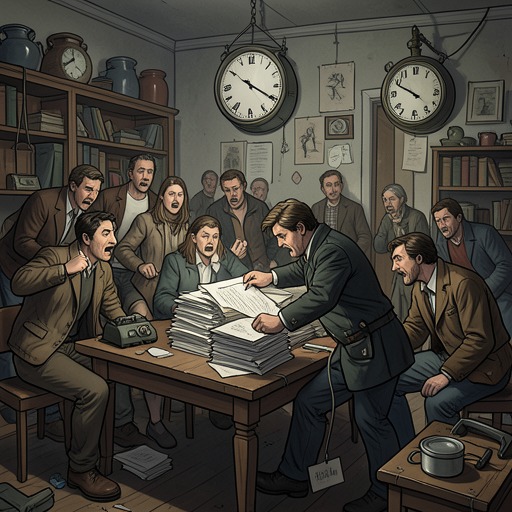
The book’s example begins with the crisis that can follow a lack of advance planning: someone assumed another person had obtained the tickets, and the omission surfaces only when urgency arrives. In that moment, the first response is action: work harder, put in overtime, add people, get busier. The impulse is to increase effort and capacity before determining what the situation actually requires.
When a crowd of busy people colliding with one another does not solve the problem, the next move is organization. People draw boxes around the difficulty and label them, or redraw the boxes and change the labels. This can make the problem look more structured without changing the work that must be done. When relabeling also fails, someone proposes brainstorming. The group is assembled and asked for a good idea, though the question arrives only after the crisis has already driven the process.
If little emerges, the response may escalate again: the manager concludes that staff creativity is depleted and brings in a consultant. The consultant eventually asks what the group is really trying to do. That question—about purpose and vision—comes last in the reactive sequence, even though it could have shaped every earlier choice. The pattern thus moves from action to organization, then creativity, and finally purpose: the reverse of natural planning.
Costs, Corrections, and Organizational Stakes
The model’s consequence is not simply that people do unnecessary work. Its delayed return to purpose means that the work can proceed without a clear account of the intended result, while urgent fixes consume time and attention. Reorganizing boxes, summoning a roomful of colleagues, and hiring a consultant may each look like progress, but none substitutes for knowing what the effort is meant to accomplish. Natural planning, the book argues, will occur in some form; the question is when it happens and what the delay costs.
The broader challenge is to establish a coherent system that operates at the level where work actually happens. Such a system must connect big-picture thinking to small open details, manage several levels of priority, handle hundreds of new inputs a day, and save more time and effort than it takes to maintain. This requirement responds to the same conditions that invite reactive planning: open-ended outcomes, cross-divisional communication, shifting responsibilities, and a steady accumulation of agreements.
Reliable collection and follow-through also matter between people. A request or relevant piece of information may arrive by voice mail, email, conversation, or written note; for coordination to work, the recipient needs it to enter a trusted system, be processed and organized, and remain available for review as a possible action. If one person tracks only voice mails while ignoring email and paper, colleagues must adapt to that limitation, and organizational communication becomes less dependable. No personal system can simply be legislated, but people can be held accountable for outcomes and for managing what comes their way.
The proposed organizational alternative is not the expectation that everyone can do everything. People will have more to do than they can complete, so agreements about what will not be done must be renegotiated continually. That requires reliable records: an agreement cannot be reconsidered if the person who made it has forgotten it, or if a commitment to someone else has disappeared from view. The contrast completes the model’s significance. Reactive planning treats crisis as the prompt to think; the more effective practice is to capture commitments and clarify intended results early enough that action, organization, and creativity serve a known purpose.